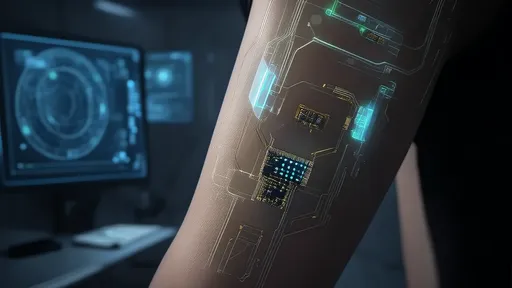
The field of wearable technology has taken a significant leap forward with the development of electronic skin (e-skin) capable of capturing high-fidelity biosignals. Unlike traditional medical sensors, e-skin adheres seamlessly to the body, offering continuous monitoring of vital physiological data such as heart rate, muscle activity, and even neural signals. However, one persistent challenge has been the interference of noise—whether from motion artifacts, environmental factors, or internal electronic fluctuations—which can distort these delicate signals. Recent advancements in noise reduction algorithms and material engineering are now addressing this issue head-on, paving the way for more reliable and clinically viable applications.
At the core of this progress lies the integration of machine learning with adaptive filtering techniques. Traditional noise-reduction methods often rely on static filters that struggle to distinguish between meaningful biosignals and irrelevant noise. Modern approaches, however, employ dynamic algorithms that learn and adapt in real time. For instance, researchers at Stanford University have developed a neural network model that analyzes the unique noise patterns generated by a patient’s movements, effectively subtracting these distortions without compromising the underlying physiological data. This is particularly critical for athletes or patients with movement disorders, where motion artifacts are unavoidable.
Material innovations are equally transformative. Engineers have begun embedding self-healing polymers and nanostructured conductive fibers into e-skin designs. These materials not only enhance signal conductivity but also minimize electromagnetic interference—a common source of noise in electronic systems. A team at MIT recently demonstrated a graphene-based e-skin patch that reduces baseline noise by over 60% compared to conventional silver-based sensors. The graphene’s atomic-thin structure allows for unparalleled signal clarity, while its flexibility ensures consistent skin contact even during vigorous activity.
Another promising avenue is the use of hybrid signal processing. By combining analog preprocessing with digital post-processing, researchers can tackle noise at multiple stages. Analog circuits embedded directly into the e-skin hardware perform initial noise suppression, filtering out high-frequency interference before it reaches the digital components. This dual-layer approach significantly reduces the computational burden on downstream algorithms, enabling faster and more energy-efficient processing. A collaboration between the University of Tokyo and Samsung has yielded a prototype that achieves real-time biosignal denoising with a power consumption of just 0.5 milliwatts—a game-changer for battery-dependent wearable devices.
Clinical validation of these technologies is already underway. In a recent study published in Nature Biomedical Engineering, e-skin equipped with advanced noise reduction was tested on Parkinson’s disease patients. The device successfully captured subtle tremors and muscle activations that were previously indistinguishable from background noise. Such precision could revolutionize how neurological conditions are monitored and treated, enabling personalized therapy adjustments based on real-time data. Cardiologists are also exploring the potential for noise-reduced e-skin to detect arrhythmias earlier than conventional ECG monitors, thanks to its ability to maintain signal integrity during daily activities.
Despite these breakthroughs, challenges remain. Scaling production of advanced e-skin materials while maintaining consistency is a hurdle, as is ensuring long-term stability under varying environmental conditions. Privacy concerns related to continuous biometric data collection also necessitate robust encryption protocols. Nevertheless, the trajectory is clear: as noise reduction techniques mature, electronic skin is poised to transcend its current niche applications, becoming an indispensable tool in healthcare, sports science, and beyond.
The convergence of materials science, artificial intelligence, and biomedical engineering has set the stage for a new era of unobtrusive, high-precision health monitoring. With each advancement in noise suppression, e-skin moves closer to fulfilling its promise—not just as a technological marvel, but as a lifeline for patients and a window into the human body’s most elusive signals.
By /Aug 7, 2025

By /Aug 7, 2025

By /Aug 7, 2025

By /Aug 7, 2025

By /Aug 7, 2025

By /Aug 7, 2025

By /Aug 7, 2025

By /Aug 7, 2025

By /Aug 7, 2025

By /Aug 7, 2025

By /Aug 7, 2025

By /Aug 7, 2025

By /Aug 7, 2025

By /Aug 7, 2025

By /Aug 7, 2025
By /Aug 7, 2025

By /Aug 7, 2025

By /Aug 7, 2025

By /Aug 7, 2025

By /Aug 7, 2025
